
Plate Cover Sensors: What They Read and How to Fit Yours
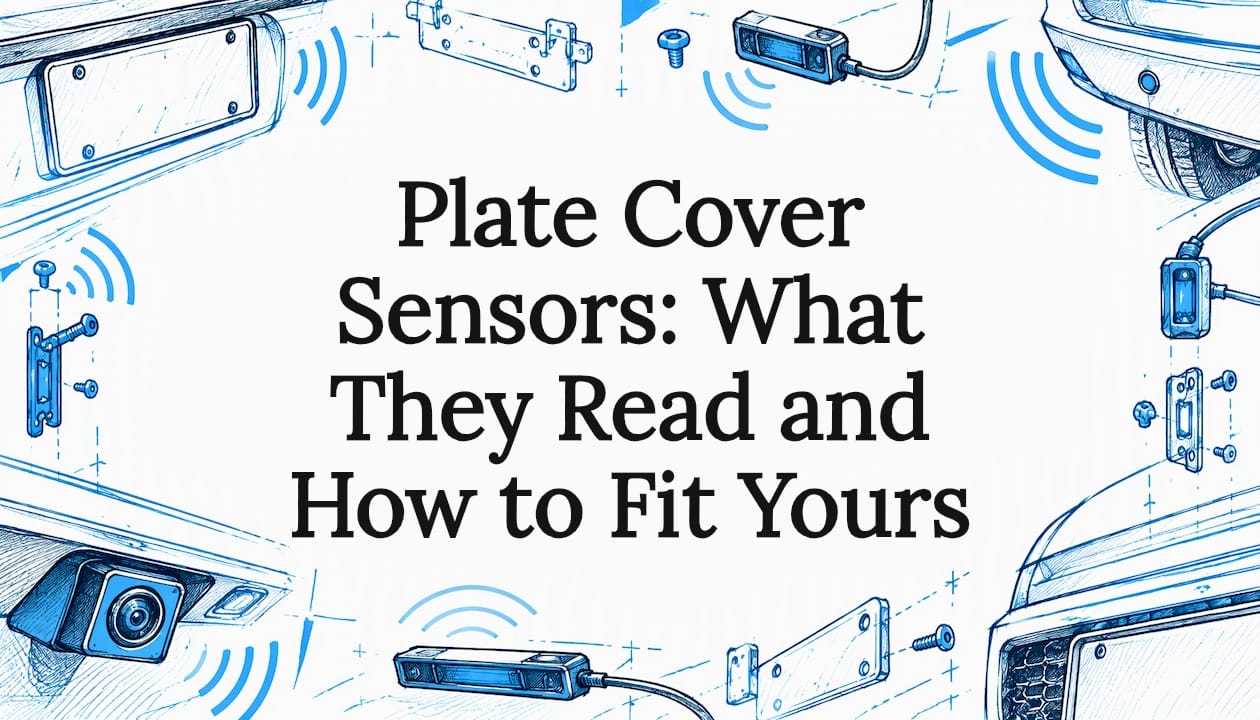
A plate cover touches three kinds of sensors: the radar and parking sensors on your own car, the plate-reader cameras that tolling and police systems use, and the toll or speed cameras along the road. Each reads a different signal, so a cover that is fine for one can cause trouble with another. The practical answer is a cover that mounts flat, stays clear of your vehicle’s sensors, and is used where the rules allow it. That is how we build the Ghost Curtain Cover at GoGhost, for off-road, motorsport and parked-car privacy.
TL;DR
- Your car’s radar and parking sensors sit behind the bumper skin. Anything placed in front of that zone can cut range and accuracy, sometimes with no warning light.
- Plate-reader and toll cameras need an unobstructed, readable plate. Public-road rules in nearly every state require exactly that.
- Plastic “distortion” covers and sprays have a poor track record against real camera systems, so they are not a reliable product category.
- Use a blackout cover where it fits the rules: off-road, on a track, at a show or on private property, and mount it clear of sensors.
- Our Ghost Curtain Cover is $129.99, fits standard US and Canadian plates and installs without tools.
Table of Contents
- What “plate cover sensors” actually means
- Your car’s own sensors: where a cover can interfere
- How plate-reader cameras treat a cover
- The rules on public roads
- Where a blackout cover fits
- How to fit a cover without touching your sensors
- Electric or mechanical: which style suits you
- Our view
- Get the cover for the way you drive
- FAQ
- Sources
What “plate cover sensors” actually means
People search this phrase for three different reasons, and mixing them up is how drivers end up with a cover that does the wrong thing.
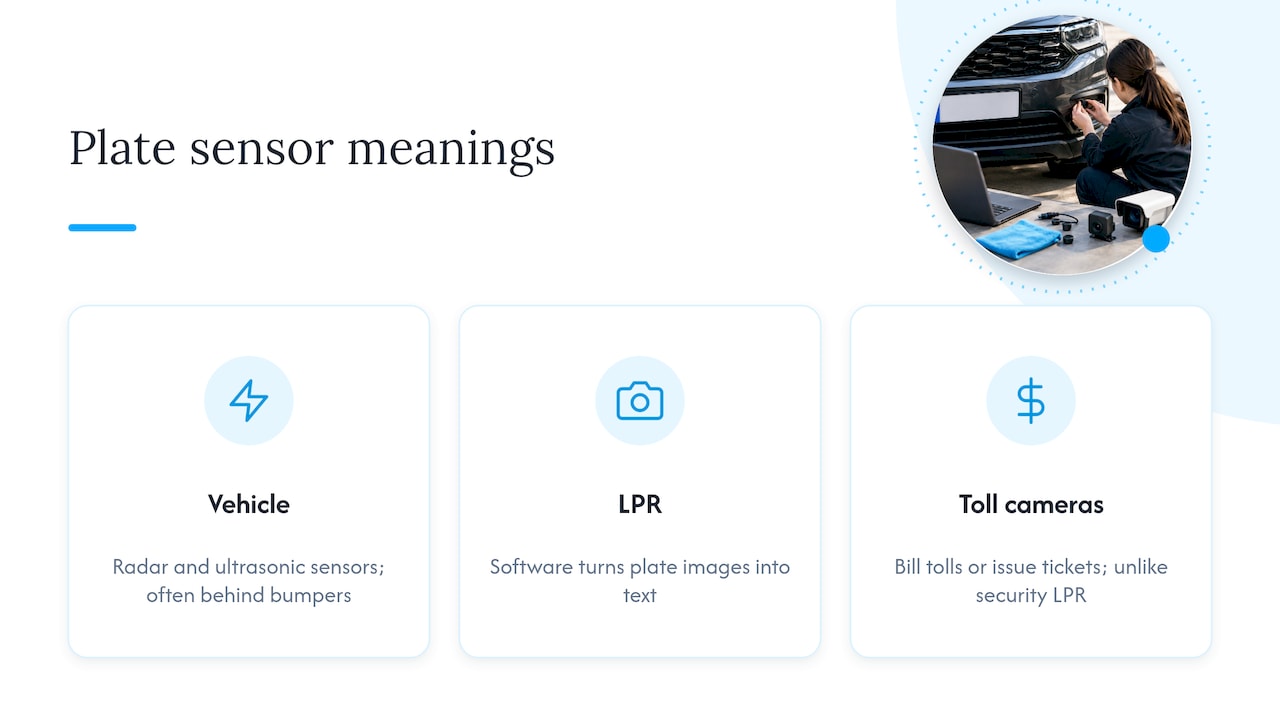
Sensors on your vehicle. Modern cars carry radar for adaptive cruise control and collision warning, plus ultrasonic parking sensors. Many of these sit behind or inside the bumper, and some front plates mount right in front of them.
Plate-reader cameras. License plate readers (LPRs) are cameras with software that turns a plate image into text. Police cars, fixed poles and highway gantries use them.
Toll and enforcement cameras. These photograph a plate to bill a toll or issue a ticket. They are not the same as the LPR cameras used for security. New York’s MTA Inspector General found that bridge and tunnel toll cameras assess tolls, while separate security LPR cameras on gantries use different technology and do not assess tolls. The same report noted that the security cameras sometimes caught a plate the toll cameras missed.
If you want a plain-language tour of how each camera type detects violations, our guide to the five traffic camera types in the US covers it.
Your car’s own sensors: where a cover can interfere
This is the part most plate-cover articles skip, and it is the one that affects every driver who adds a bracket, frame or cover to a front bumper.
SEMA, the specialty-equipment trade association, explains in its guidance on ADAS compatibility that radar sensors are designed to work through the original bumper fascia. Putting something in front of the radar can reduce range, sensitivity and wave accuracy. Automakers generally accept about a 10% range reduction from a bumper cover, and radar performance can degrade without an error code or a dashboard light. SEMA’s Nick Dominato advises matching the original bumper’s material, thickness and curvature within the 12-by-12-inch radar area.
What that means for a plate cover:
- Do not stack hardware over the radar zone. A thick bracket, a second plate or a cover with an electronics box is the kind of addition that sits in front of a sensor.
- Do not drill blind. A CarParts.com guide reviewed by an ASE Certified Master Technician recommends checking behind the bumper for wiring, sensors or shutters before drilling, and relocating a plate that blocks a sensor, camera, lamp or airflow opening.
- Keep it flat. The same guide advises test-fitting a bracket so it sits flat and does not block cameras, parking sensors, cooling openings, tow points or auxiliary lights.
A cover that clips over the plate you already have, without new holes and without adding depth in front of the bumper, avoids most of this. That is the reason tool-free installation matters beyond convenience: no drilling means no surprise behind the panel.
How plate-reader cameras treat a cover
A plate reader needs a clear, high-contrast image of the characters. Anything between the lens and the plate changes that image.
A Seal Beach, California police captain explained in a March 2025 briefing that LPR cameras need a clear, unobstructed view, that even clear covers can create glare or distort the numbers, and that frames are legal only when they do not block the numbers, the state name or the registration stickers.
That is also why ordinary tinted or smoked covers cause trouble on the road: they were not designed with any camera in mind, and the glare they add can make a plate unreadable to a system that is expected to read it.
What the testing shows about gimmicks
The track record of cheap anti-camera products is poor:
- In a CBS News test with a real speed-camera rig, plastic distortion covers and a plate spray did not block any shots. A technician could read every covered plate after reversing the image.
- CBS New York followed three drivers who bought reflective film strips (one paid $56 for two) and were still photographed. The seller’s own email conceded that modern traffic cameras, infrared flash strength and nearby lights can reduce the film’s effect.
- The NYC comptroller found the city’s congestion-pricing cameras reject more than 20% of images because of fake or covered plates. That is a sign systems are being built to catch exactly this.
The lesson is not that you need a stronger gimmick. It is that a passive film or lens is the wrong tool for any purpose. A cover that fully closes over the plate on demand is a different category: it is meant for situations where the plate should not be visible at all, such as a car parked at a show, a car on a trailer, or a vehicle on a closed course or private trail.
The rules on public roads
On a public road, your plate has to be visible and readable. That is the rule behind everything above, and it is the part of this topic where we want you to be exact.
- Blocking a plate is illegal in almost every state, according to AAA Northeast. New York, Tennessee, Washington and Pennsylvania have laws that specifically ban plate flippers.
- New York: a law that took effect September 1, 2024 bans selling plate covers designed to obscure plates, raises fines to $100 to $500 and allows a 90-day registration suspension after three or more convictions within five years. NYC DOT rules effective April 16, 2025 also require plates to be free of any glass or plastic covers.
- California: Vehicle Code 5201, as amended by AB 1085 and effective January 1, 2026, bars any casing, shield, frame, tint or device that impairs reading of a plate by law-enforcement, toll or remote emission-sensing electronics. The bill text sets $250 per violation for operating a vehicle with a prohibited device.
- Florida: HB 253, effective October 1, 2025, makes knowingly driving with a device that blocks or obscures a plate a second-degree misdemeanor, per a 2026 legal guide.
- Federal: a bill introduced in March 2026 would outlaw plate covers and toll-evasion devices nationally. It is a proposal, so check its status before relying on it.
The details differ by state, and some states allow clear frames that leave all plate information visible. For a state-by-state view, see our guide to US license plate cover laws. If you are unsure how a rule applies to your car, ask your state DMV or a local attorney before you drive with any cover.
One point drivers often overlook: toll tags are a separate system from plates. Our piece on toll tag interference explains why a cover and a transponder are not the same question.
Where a blackout cover fits
Our products exist for situations where a plate is not in service as an identifier, and where privacy is the point.
- Off-road and trail driving. Mud, brush and private land do not need a plate on display, and a cover that closes keeps the plate clean and shielded.
- Motorsport and track days. On a closed course, the plate has no role. A weather-sealed cover keeps it protected between sessions.
- Shows, shoots and meets. A car parked at an event often gets photographed and posted. Our guide to parked-car plate privacy goes through that use.
- Trailer and storage transport. When a vehicle is loaded on a trailer, its plate is not the one that identifies the rig.
Before you drive on a public road, open the cover so the plate is fully readable. If you want a wider look at the options, our overview of license plate privacy options compares the main types.
How to fit a cover without touching your sensors
Whether you buy ours or not, run through this order. It protects your radar, your parking sensors and your plate’s legibility.
- Find your sensors. Check your owner’s manual for where the radar and parking sensors are. Front plates are the usual problem, because the radar often sits right behind them.
- Look behind the bumper. Wiring, sensors and shutters can sit exactly where a screw wants to go. Check before you drill anything.
- Choose the mount that adds the least depth. A cover that sits flush with your plate keeps the stack thin. Depth in front of radar is what SEMA warns about.
- Confirm the footprint. US and Canadian standard plates are the same size, so a universal-fit cover should seat evenly on all four sides without bowing.
- Seal and tighten. Loose covers rattle, collect water and shift. A weather-sealed build keeps moisture out of the plate area.
- Check legibility with the cover open. The numbers, the state name and the registration tags should all be visible. Visibility basics such as keeping plate numbers and state names clear apply to every frame.
- Re-check after a few days. Vibration loosens things. Confirm that the cover still sits flat and your sensors behave normally.
Where our covers help is steps 3 to 5. They install without tools, fit all standard US and Canadian plates, and are weather-sealed, so you are not building a bracket stack in front of the bumper.
Electric or mechanical: which style suits you
We make two styles because drivers use them differently.
| Electric glass cover | Mechanical sliding curtain | |
|---|---|---|
| How it works | A switch makes the glass opaque instantly | A manual curtain slides across the plate |
| Control | Wireless remote | Hand operated |
| Fit | Universal for US/CA standard plates | Universal for US/CA standard plates |
| Installation | Tool-free, quick | Tool-free, quick |
| Best for | Quick changes at a show or on a trail | Simple, no-electronics use |
The Ghost Curtain Cover is the mechanical option, priced at $129.99. Because it has no electronics, there is nothing to wire near your bumper, which keeps the sensor question simple.
Our view
Most of what people read about plate covers lumps everything together: a $20 film, a tinted lens and a cover that closes completely are treated as the same thing. They are not.
A film or lens is passive. It hopes to confuse a camera, and the tests that exist show that hope is misplaced. A cover that closes fully is a deliberate tool with a deliberate place: the show field, the trail, the track, the trailer.
We build for that. Our covers fit standard US and Canadian plates, install without tools and are sealed against weather, so you can fit one in minutes and avoid drilling behind the bumper. We offer an electric version with a wireless remote and a mechanical curtain, because some drivers want a switch and others want nothing to wire.
And we say plainly what you already know: when you are on a public road, your plate must be readable, so open the cover before you drive. Know your state’s rule and use the product where it belongs.
GoGhost
Get the cover for the way you drive
If you spend weekends off-road, at track days or at car meets, the Ghost Curtain Cover is $129.99. It fits standard US and Canadian plates, installs without tools and is weather-sealed. Drivers who buy from us join the more than 10,000 drivers who use GoGhost products, and our reviews average 4.9 stars across nearly 3,000 ratings. We ship the same day.

Have questions about fit on your vehicle? Browse our blog guides or start from goghost.store.
FAQ
Can a plate cover damage my car’s radar or parking sensors?
It can if it adds material in front of the sensor. SEMA notes that radar performance can degrade without any warning light, and automakers generally accept only about a 10% range reduction from a bumper cover. Keep covers thin, flat and clear of the radar area, and check behind the bumper before drilling.
Do plate covers stop toll cameras from reading a plate?
Passive covers, sprays and films have not held up in published tests, and toll agencies are adding detection of their own. New York’s MTA says it uses machine learning and sensors to alert officers when cameras fail to capture a plate. Rules on public roads require a readable plate anyway.
Are blackout plate covers legal?
On public roads, almost every state requires the plate to be visible, and several have laws aimed at flippers and obscuring devices. Rules differ by state, so check yours with your DMV. Off-road, on a closed course and at a parked show, the privacy use is different, but open the cover before you drive on the street.
Will a cover fit my vehicle?
US and Canadian standard plates share one size, and our covers are made to fit them. They suit cars and motorcycles and install without tools.
Should I put a cover on a front plate with radar behind it?
Check where the radar sits first. A thin cover that does not add stack depth is the safer choice, and a plate that blocks a sensor should be relocated rather than forced into place.
Sources
- MTA Office of the Inspector General report on toll cameras
- SEMA: Designing and installing products to ensure ADAS compatibility
- CarParts.com: How to install a license plate bracket
- Briefing Room: California law prohibits license plate covers
- CBS News: Can you foil the photo cop?
- CBS New York: NYPD cracks down on illegal license plate covers
- CBS New York Investigates: illegal license plate covers and congestion pricing
- AAA Northeast: Are license plate covers illegal?
- New York DMV consumer alert on plate covers
- NYC DOT final rules on obscured plates
- California Vehicle Code 5201
- California AB 1085 bill text
- BGBlur: License plate concealer devices legal guide
- NJ.com: Federal ban proposed on plate covers and ghost plates
- All Star Truck Parts: License plate light requirements