
Magnetic Plate Cover Issues: Fit, Fall-Off and Legal Risk
Most magnetic plate cover problems come down to three things: the magnet does not grip the panel you chose, the plate works loose at highway speed, or the cover blocks the plate in a way your state treats as a violation. If you want privacy or a fast install, a purpose-built, weather-sealed cover with a defined mount solves the first two. Whichever route you take, you still need to check the third against your own state’s law. Below we cover each problem, how to test for it, and what to do instead.
TL;DR
- Magnets only grip steel. Aluminum, fiberglass, plastic bumpers and thick body filler give them little or nothing to hold.
- A plate that feels secure in a parking lot sees far higher forces at speed. Too few magnets, dirty adhesive or a flexing bumper are the usual causes of fall-off.
- A magnetic cover that hides or distorts the plate can break state law. Washington, New York City, California and Florida each have their own rules.
- Our Ghost Curtain Cover is a mechanical sliding-curtain cover built to fit standard US and Canadian plates and to install without tools.
Table of Contents
- What people mean by a magnetic plate cover
- Issue 1: the magnet has nothing to grip
- Issue 2: the plate comes loose at speed
- Issue 3: plate lighting, sensors and visibility
- Issue 4: the legal side
- Issue 5: DIY fixes that make it worse
- What a purpose-built cover changes
- Getting your own setup right: a checklist
- Our perspective
- The Ghost Curtain Cover
- FAQ
- Sources
What people mean by a magnetic plate cover
The phrase covers several different products. Some are magnetic plate holders: the plate attaches to the car with magnets instead of screws, so you can pull it off for a photo shoot or a car show. Others are magnetic display covers: a decorative or privacy panel that snaps onto a frame or onto the plate screws. A third group is magnetic bars that stick to the back of a plate or cover and grip a steel bumper or tailgate.
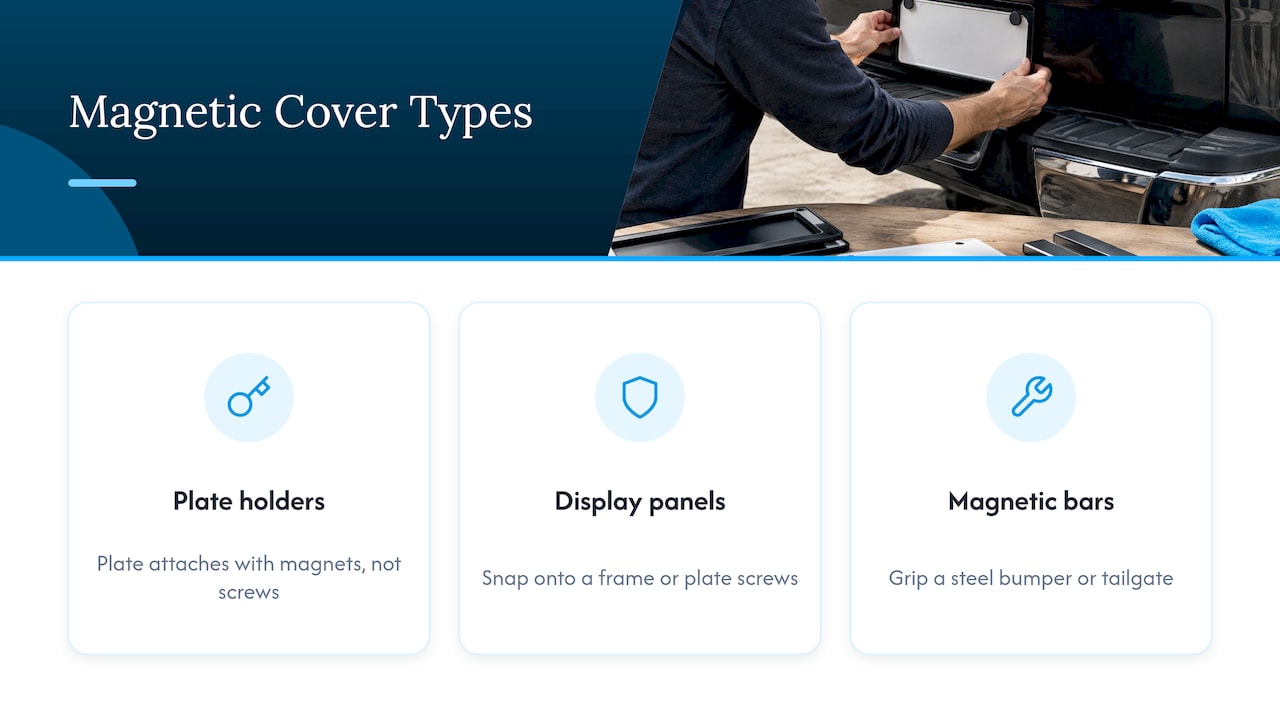
The common promise is speed. No drilling, no screwdriver, and the plate comes off in seconds. That is real, and for a parked show car it works. The trouble starts when the same setup has to stay on a moving vehicle for months, through car washes, winter road salt and highway wind.
If you want a closer look at the types of privacy product available, our guide to license plate privacy options walks through five of them.
Issue 1: the magnet has nothing to grip
A magnet sticks to ferrous metal, which means steel or iron. Many modern bumpers are plastic, and many tailgates and trunk lids are aluminum, carbon fiber or fiberglass. Put a magnet on any of those and it does nothing on its own.
This is why most magnetic systems add a second part: magnetic bases fixed to the bumper with adhesive pads, screws or the existing plate holes, so the bumper itself does not need to be magnetic. K&J Magnetics, a magnet manufacturer, describes two common US approaches in its magnetic license plate holder guide: sandwiching the plate between adhesive magnets on an existing front mount, or installing neodymium magnets behind a plastic bumper, which can mean removing the splash shield or even the bumper itself. That is a bigger job than the phrase “no drill” suggests.
The 60-second fit check
- Take a small fridge magnet to the spot where the plate sits.
- Press it flat on the panel. If it snaps on firmly, the panel is steel.
- If it slides or barely clings, the panel is aluminum, plastic or composite, and you will need a mount that screws or bonds to the car.
- Try several spots. Body filler from a past repair can sit under the paint and weaken the pull.
- Check the surface is flat. A curved or flexible bumper area weakens an adhesive mount.
The same check applies to the frame. Many plate frames are aluminum or plastic, so a magnet that works on a steel plate may not hold a cover to the frame.
Issue 2: the plate comes loose at speed
A plate that feels solid when you wiggle it in the driveway is not tested until the car is at 70 mph. A garage guide from Ryan’s Auto Care notes that magnetic holders can fail in high-speed wind or extreme temperatures and advises checking local regulations first. The usual causes are:
- Too few magnets. Kits are designed around a set number. K&J’s testing found that two corner magnet pairs hold well, while four hold very securely.
- A weak adhesive bond. Wax, ceramic coating residue, road film and silicone tire or trim dressing all stop adhesive pads from bonding. Clean the surface with isopropyl alcohol and let it dry before fitting.
- A flexing surface. A bumper cover that bends in the wind lets the bond peel from the edge.
- Thin plates. A magnet bonded to a thin, flexible plate can pull away at the edge.
- Grit and corrosion. Road salt and trapped debris under the magnet reduce holding power far more than the magnet aging does.
Here is a worked example. Say you fit a magnetic cover with adhesive bars in October. By January, salt spray and two car washes have worked under one bar. The cover looks fine, but one edge now flutters at highway speed. A few weeks later it is gone, and you may not notice until you see the empty bumper. Driving without a legible plate is also what gets you pulled over.
As a routine, look at the mount every few weeks: press each corner, check the bond line for lifting, and wipe out grit. That is an ongoing chore, not a one-time install.
Stronger is not always better
Over-strong magnets bring a different problem. They are hard to separate, so people twist or pry the plate off at an angle, which can bend it or crack a plastic mount. The goal is secure retention with a controlled way to remove it.
A tailgate-mounted plate can also pick up vibration that bumper mounts do not, so check the mount more often after rough roads or off-road runs.
If you are comparing bumper-side options, this front and rear bumper magnetic mounts buyer’s guide covers vehicle and bumper compatibility for photo shoots, detailing and events.
Issue 3: plate lighting, sensors and visibility
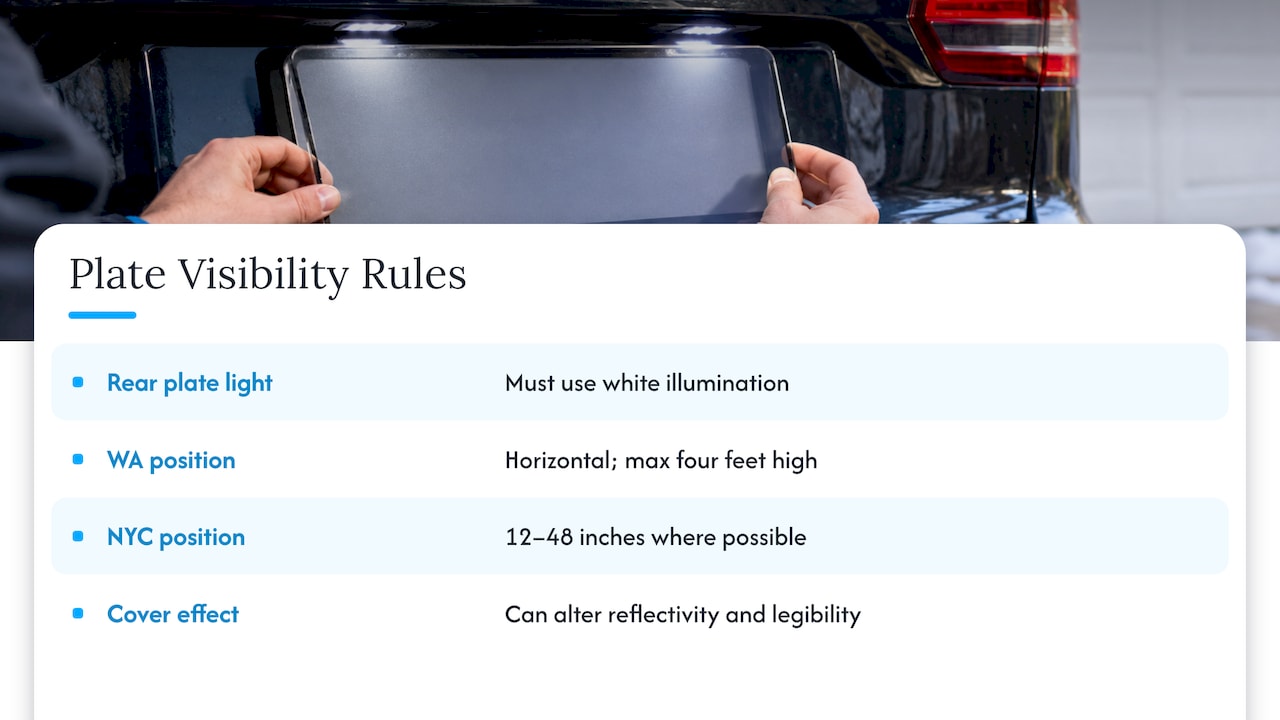
A magnetic cover that sits over the plate, or a holder that shifts the plate position, can change what the plate looks like to the eye and to a camera. Washington State Patrol points out that rear plates must be illuminated by a white light and that tinted and non-tinted covers can alter reflectivity and make plates unreadable. If a cover sits proud of the plate, it can also throw a shadow on the lamp area or clip the edge of the light.
Mounting position matters too. Washington’s statute requires plates to be horizontal and no more than four feet from the ground, and New York City’s rules call for a position between 12 and 48 inches where possible. Moving a plate to a magnetic mount in a lower, angled or recessed spot can break those rules even if the plate itself is clean.
Before you fit anything near a bumper, also check it will not interfere with parking sensors, cameras or airbags, as Ryan’s Auto Care advises.
Issue 4: the legal side
This is the biggest reason magnetic covers get drivers in trouble, and it is why you should read your own state’s rule before you buy any cover. The rules vary by state, and some changed recently.
| Place | What the rule says | Source |
|---|---|---|
| Washington | Plates must stay clean, uncovered and plainly readable. Holders, frames or covers that conceal, obstruct or distort a plate are unlawful. | RCW 46.16A.200 |
| New York City | Plates must be securely fastened and readable, with no glass or plastic covers. Anything that distorts or reflects light so cameras cannot read the number is prohibited. | NYC DOT announcement |
| California | Covers are banned except in limited cases, and so are devices that impair electronic reading of a plate. | AB-1085 text |
| Florida | Material that interferes with a plate’s legibility, angular visibility or electronic recording is prohibited. | Florida Statutes 320.061 |
Some numbers help show the stakes. Washington’s cover ban took effect June 6, 2024, with warnings first. From January 1, 2025, officers could cite, and Spokane Police reported the ticket at $237 as a primary offense, meaning an officer can stop you for it alone. Fines for plate obstruction elsewhere typically run $50 to $200, according to Autotrader, which also notes that motorized or electronic covers are generally assumed to be meant to stop traffic or toll cameras from recording plates. And AAMVA, the association of motor vehicle administrators, takes the position that plates should be completely unobstructed and clearly visible to both people and technology.
That is why a thin decorative magnetic cover over the plate on a public road is a gamble in many places. The question is not whether the magnet holds. It is whether the plate is legible, lit and seen as you drove it. Our state-by-state cover law guide goes through how the rules have shifted, and it is worth reading before you choose any cover for road use.
For a car that is parked at a show, a shoot or a meet, privacy is a different question, and we cover it in parked car plate privacy. Wherever you drive, follow the plate rules of your state and check your local law on toll and camera enforcement.
Issue 5: DIY fixes that make it worse
When a magnetic cover fails, people reach for tape, zip ties or extra adhesive. That tends to add a new problem: a cover that now cannot be removed quickly, with edges that flap, and a plate that looks tampered with. Drivers who go this way often draw attention they wanted to avoid, which is the point of our piece on why DIY plate covers trigger stops and fines.
A better fix is to start with a product designed for the job: a defined mount, a sealed housing and a known fit, instead of a stack of adhesive and magnets.
What a purpose-built cover changes
Most of the issues above share a root: a magnet is being asked to do a job it was not designed for. It has to grip a surface that may not be steel, survive weather, hold a plate at speed and release cleanly on demand. A purpose-built cover removes those variables.
Here is how our approach lines up against each issue:
| Magnetic cover issue | What we built the Ghost Curtain Cover around |
|---|---|
| Panel is not steel | Universal fit for standard US and Canadian plates, so you are not matching a magnet to a panel material |
| Fiddly, easily botched install | Tool-free, quick installation |
| Weather and road salt | Weather-sealed construction |
| Needing a different product for each vehicle | Cars and motorcycles are both covered, in electric and mechanical versions |
On the install itself, the steps are short, and our tool-free plate cover install guide walks through fit and legal limits. If you ride a motorcycle, the motorcycle plate privacy guide covers the four types and how they fit. For SUV owners with a tailgate plate, SUV rear plate privacy covers options and fit.
Getting your own setup right: a checklist
Whichever cover you choose, run through this before you drive.
- Check your state’s rule first. Read the statute or your state police page. Covers that hide, tint or distort a plate are restricted in many places.
- Confirm the mounting surface. Magnet test for steel. If it is plastic or aluminum, plan on a screw or bolt mount.
- Clean before you fit. Strip wax, coating residue and film from any bonding area.
- Use the full set. Do not split a kit across two plates or skip pieces.
- Check the plate light. The cover must not shadow or block the white rear plate lamp.
- Re-inspect every few weeks. Press each corner and look for lifting or grit, especially after winter.
- Keep the plate readable and in the right position. Horizontal, within your state’s height range, and free of anything that blocks letters, numbers or tabs.
Our perspective
Drivers who come to us after a magnetic cover failed usually have the same story: it held in the driveway and not on the highway. The mount, not the magnet, was the weak point.
We built our range around that lesson. We offer both electric and mechanical blackout covers, so a driver can choose between a flip-of-a-switch electric version with a wireless remote and a manual sliding curtain. Both are designed to fit standard US and Canadian plates, install without tools and stand up to weather.
Our view is simple. If you want a cover you can fit in minutes and trust on the road, start with one designed as a complete unit, not a magnet stuck to whatever panel your car happens to have. Then check your state’s rules before you drive.
GoGhost
The Ghost Curtain Cover
If you want a cover that does not depend on what your bumper is made of, the Ghost Curtain Cover is our manual sliding-curtain option at $129.99. It is designed to fit standard US and Canadian plates, installs without tools and is weather-sealed. We ship the same day, and more than 10,000 drivers use our covers, with a 4.9-star rating from nearly 3,000 reviews.

Check your state’s plate rules before using any cover on a public road.
FAQ
Can a magnetic license plate cover fall off while driving?
Yes, it can when the mount is wrong for the car. Using too few magnets, a weak adhesive bond or a flexing bumper surface are the usual causes, and wind at highway speed puts far more force on the plate than a parking lot does. Inspect the mount every few weeks and keep the surface clean.
Will a magnet stick to an aluminum or plastic bumper?
No. Magnets only grip steel or iron. On aluminum, fiberglass, carbon or plastic you need a mount that screws or bonds to the car, with the magnet fixed to that base. Hold a small magnet to the spot to test it, and check for body filler too.
Are magnetic plate covers legal in the US?
It depends on the state and on the cover. Washington, New York City, California and Florida all restrict covers or materials that obstruct or distort a plate or interfere with electronic reading. Read your state’s statute or state police page before you fit one, and ask your state’s DMV or highway patrol if you are unsure.
Can magnets stop working over time?
Permanent neodymium magnets lose very little strength over years. Failures usually come from physical damage, corrosion, road salt, trapped debris or poor installation. Keeping the mount clean and checking it regularly addresses most of these.
Sources
- Magnetic License Plate Holder, K&J Magnetics Blog
- How to attach a license plate without drilling, Ryan’s Auto Care
- Vehicle & Equipment Requirements, Washington State Patrol
- RCW 46.16A.200, Washington State Legislature
- Winter Driving Reminders and a New Law, City of Spokane Police
- NYC Finalizes New Rules to Crack Down on Obscured License Plates
- AB-1085 License plates, California Legislature
- Florida Statutes 320.061, Online Sunshine
- License Plates Should Not Be Obscured, AAMVA
- License Plate Cover: Is It Legal? Autotrader