
Scratch-Resistant Plate Covers: What Works and What to Know
A scratch-resistant plate cover is a rigid shield, usually polycarbonate or acrylic with a hard coat, that sits over the plate face and takes the abuse instead of the plate. The best ones stay clear, stay flat and fit your plate’s screw holes without rattling. If you also want control over who can read your plate, our Ghost Curtain Cover is a weather-sealed, tool-free, universal-fit option for $129.99. Below you will find how the materials differ, how to fit a cover, and where state law draws the line.
TL;DR
- A hard-coated polycarbonate or acrylic cover shields a plate from road debris, UV fading and moisture, but a cover that scratches or yellows can itself make the plate hard to read.
- Standard U.S. plates mount with two or four screws, and stainless steel or zinc-plated hardware keeps bolts from fusing to the bumper.
- Cover rules vary by state: clear covers are banned outright in six states, and Hawaii prohibits any cover.
- For off-road and motorsport use, fit and sealing matter more than looks, because mud, vibration and stone chips attack a plate fast.
- Our Ghost Curtain Cover is built weather-sealed, installs without tools and fits standard U.S. and Canadian plates.
Table of Contents
- What a scratch-resistant cover does for a plate
- Materials and coatings: what affects scratching, clarity and durability
- How to fit a cover securely
- State rules: know them before you buy
- Off-road and motorsport use
- Choosing between a clear cover and a privacy cover
- The Ghost Curtain Cover
- Our perspective
- FAQ
- Sources
What a scratch-resistant cover does for a plate
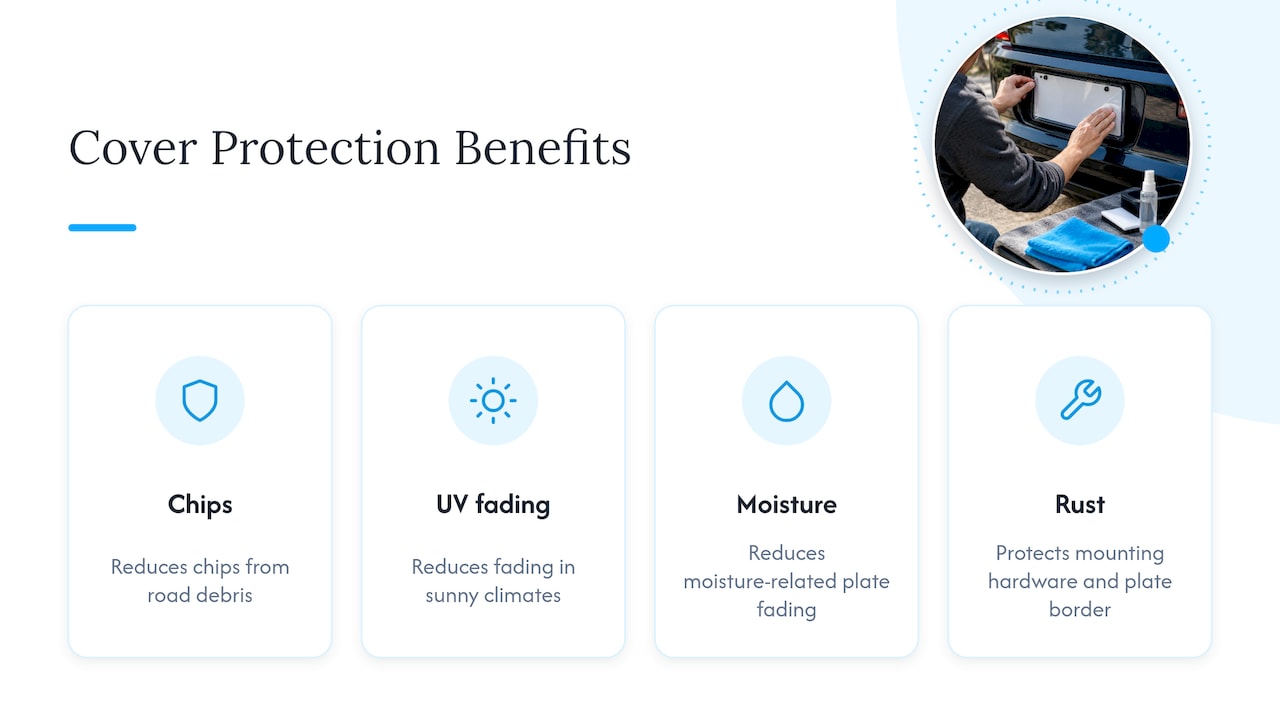
A plate takes a beating. It sits at bumper height, takes gravel, road salt, car-wash brushes and years of sun. A full cover is a plastic or polycarbonate shield that snaps over the entire face of the plate. According to BuyOnceRight’s 2026 buying guide, a clear UV-resistant polycarbonate cover protects against chips from road debris, UV fading in sunny climates, moisture that fades plate numbers, and rust on the mounting hardware and plate border.
There is a second reason to care about scratches. Plate readers, police officers and toll systems all need to read the characters. Colorado’s rules, as Denver7 reports, say a cover should not be so scratched that the plate or tabs cannot be seen. A cover that hazes over after two winters stops protecting and starts causing problems. That is why scratch resistance is the feature to shop on, ahead of price or style.
Materials and coatings: what affects scratching, clarity and durability
Two clear plastics dominate plate covers: polycarbonate and acrylic. They trade strength for surface hardness.
| Property | Polycarbonate | Acrylic |
|---|---|---|
| Impact strength | Very high, about 30 times acrylic | Lower, can crack on a hard hit |
| Surface scratching | Scratches easily without a hard coat | Naturally harder surface |
| Light transmission | About 88% | About 92% |
| UV weathering | Needs UV-stabilized grade | Weathers better in standard grades |
The figures come from a plastics comparison from Ready Plastics. In practice, that means:
- Polycarbonate with a hard coat gives you impact toughness and a surface that resists swirl marks. This is the usual choice for a cover that has to survive stone chips.
- Uncoated polycarbonate is tough but marks easily. Look for the words hard-coated, anti-scratch and UV-resistant together.
- Acrylic resists everyday scratching and keeps clarity, but a sharp impact is more likely to crack it.
Features worth checking
- UV protection or anti-yellowing. Sun turns cheap plastic cloudy, and cloudy is unreadable.
- A flat, glare-free surface. A cover that adds glare or curves the surface can fail visibility rules. Missouri, for example, allows a transparent cover if the plate stays plainly visible and keeps its reflectivity, according to a state-by-state review.
- A snug fit. Gaps let water and grit in, and loose edges rattle at highway speed.
- Included hardware. Most covers and frames ship with screws, and the BuyOnceRight guide recommends stainless steel or zinc-plated screws.
How to fit a cover securely
Fitting is a five-minute job if you check a few things first.
- Count your plate holes. Standard U.S. plates use two screws for two-hole plates and four for four-hole plates, per the BuyOnceRight guide. Some vehicles and states differ, and our guide to 7 inch U.S. license plate hole spacing covers the standards and the fixes when holes do not line up.
- Check your plate count. Some rear-only states need protection on one plate, while front-and-rear states mean you will fit two covers.
- Clean the plate. Grit trapped under a cover grinds against the plate surface every time the car vibrates.
- Use rust-resistant screws. Stainless steel or zinc-plated screws prevent the situation where rusted hardware fuses to the bumper and makes removal a struggle.
- Tighten evenly and check for rattle. Snug the screws a little at a time so the cover does not flex or crack.
- Confirm the plate is fully readable. Check that every character, the state name and the registration tabs are visible, including from an angle.
On temporary paper plates, the same guide says a clear cover is acceptable when it does not obstruct any printed information. And on warranty worries: the guide notes a plate cover cannot void a vehicle warranty under the Magnuson-Moss Warranty Act unless the manufacturer proves the cover caused the specific problem claimed.
SUV and truck owners often face odd mounting surfaces, and our post on SUV rear plate privacy, options, rules and fit walks through them. If you drive a lease, read leased car plate covers, rules, lease terms and fit first.
State rules: know them before you buy
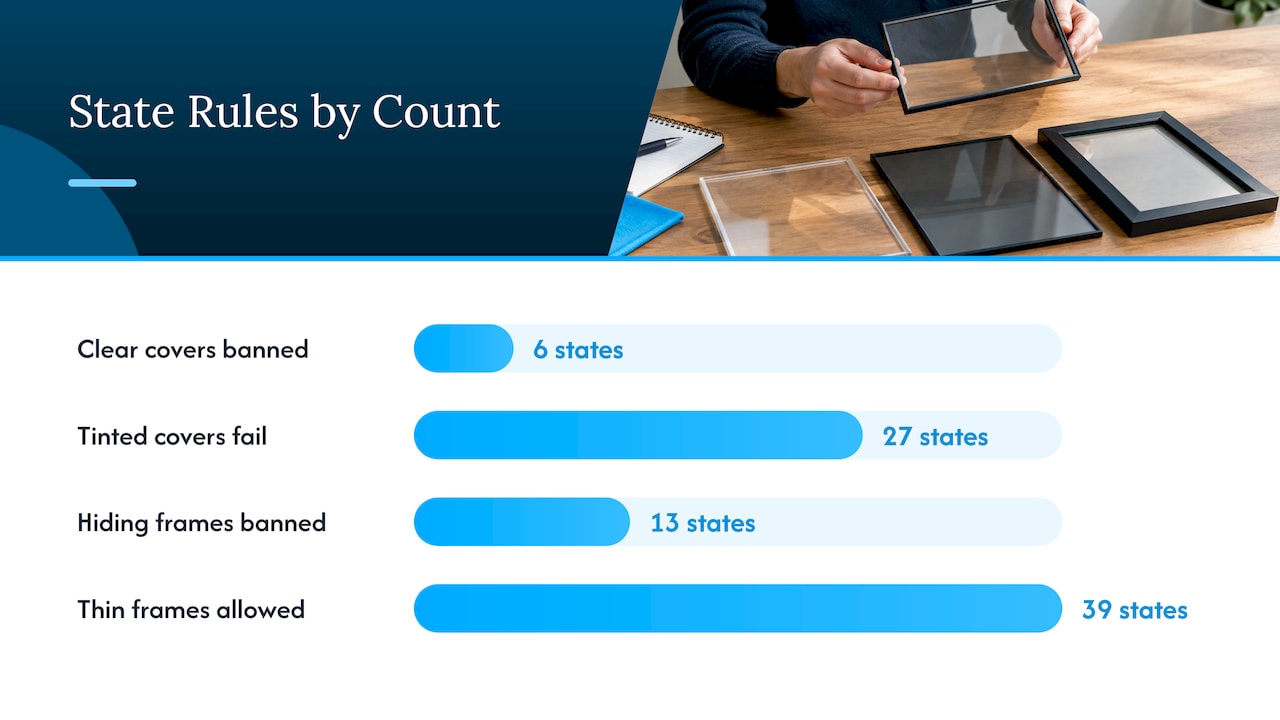
Is it illegal to have a cover around your license plate? It depends on the state, and the rules have teeth. As of a November 20, 2026 check of state codes, isitstreetlegal.com reports that clear covers are banned outright in six states: California, Illinois, Maryland, New York, Vermont and Washington. Smoked or tinted covers fail in 27 of the 39 states checked. A thin frame that hides nothing is allowed in every state checked, but frames covering the state name, tabs or numbers are banned by name in 13 states.
A few examples show how different the wording is:
- Hawaii: HRS §286-73 prohibits any cover or shield over a plate, whether clear, tinted, mirrored or reflective, with fines of $500 to $1,000 per offense, and each day counts as a separate offense.
- Colorado: Statute CRS 42-3-202(2)(b) targets devices that make a plate unreadable by automated systems, including covers that are smoked, tinted, scratched or dirty. Denver7 puts the fine at about $135 plus three points.
- Texas: Transportation Code §504.945(a)(7) bars coverings that distort angular visibility or cover letters, numbers or plate color. CityRuleLookup’s Texas page explains that a cover need not hide anything from a driver behind you to fail: if it defeats a reading taken at an angle, as toll gantries and plate readers do, it fails.
The pattern is consistent: a cover is safest when it hides nothing, adds no glare and stays unscratched. Laws change, so confirm your state’s current statute with your state motor vehicle agency before you buy. Our overview, U.S. license plate cover laws since 2026, collects the rules in one place, and if you have already received a citation, five steps to fix a plate cover ticket lays out what to do next.
Off-road and motorsport use
Trails, dirt tracks and gravel roads punish a plate in ways a commute never does: mud packs behind the cover, stones chip the surface and washboard vibration works loose any weak mount.
What matters on a rough-use vehicle:
- Sealing. A cover that keeps mud and water out of the gap protects the plate and keeps it legible after a wash.
- Secure mounting. Use all the screw holes your plate has, with rust-resistant hardware, and recheck after a rough run.
- Easy cleaning. A smooth surface wipes clean in seconds, which keeps the plate readable on the road home.
- Use on the right ground. Private tracks and closed events have different rules from public roads. When you drive back on a public road, state plate rules apply again.
Our Ghost Curtain Cover is designed with weather-sealed construction and tool-free quick installation, and the product line is made with off-road and motorsport drivers in mind. It fits standard U.S. and Canadian plates, for cars and motorcycles.
Choosing between a clear cover and a privacy cover
A clear cover and a privacy cover solve different problems. A clear cover is about wear: it keeps the plate looking new. A privacy cover is about who sees the plate and when.
The second group of drivers is large. Many people want to keep a plate out of photos at car shows, at the track or while parked, and some want fewer plate captures from automated cameras. We cover the main approaches in license plate privacy options: five types, U.S. rules and on-demand blackout. Rules on covers that block toll or enforcement cameras are strict in many states. Illinois is a clear case, and our post on toll camera avoidance and Illinois law explains it. For anyone using a cover on public roads, read the rules for your state first. Our post on toll tag interference and plate covers covers a related point worth knowing.
The Ghost Curtain Cover
If you want a cover that goes beyond a static shield, the Ghost Curtain Cover is the one to look at. It is a mechanical blackout cover with a manual sliding curtain, priced at $129.99. It is built to be weather-sealed, installs quickly without tools and fits all standard U.S. and Canadian plates, so you do not have to hunt for a model to match your car. More than 10,000 drivers use GoGhost products, and our customers rate us 4.9 stars across nearly 3,000 reviews. We ship the same day.

We also make an electric version that uses electric glass and a wireless remote, so you can choose the mechanical curtain or the electric option for the way you drive.
Our perspective
Most plates fail from neglect, not from one big event. Sun, salt and grit slowly turn a legible plate into a faded one, and a cheap cover that clouds up only speeds that along. That is why we think of a plate cover as hardware, not decoration: it should seal, mount firmly and be easy to clean.
The drivers we build for want more than protection. They want to decide when their plate is visible. That is why we offer both electric and mechanical blackout covers, with universal fit for standard U.S. and Canadian plates and installation that does not need tools. You should not need a workshop to change how your car carries its plate.
Whatever you mount, learn your state’s plate rules first. They differ a lot from one state to the next, and a few minutes of reading saves a ticket.
GoGhost
FAQ
Is polycarbonate or acrylic better for scratch resistance?
Acrylic has a naturally harder surface and resists everyday scratching, while polycarbonate is far tougher against impact but marks easily unless it has a hard coat. For a plate that sees stone chips, a hard-coated polycarbonate cover is the usual pick. Check that the listing says hard-coated and UV-resistant.
Can a scratched plate cover get me a ticket?
It can. Colorado’s rules, as reported by Denver7, say a cover should not be scratched to the point that the plate or tabs cannot be seen. Replace a hazy or scratched cover instead of waiting for it to be flagged.
Do plate covers void a car warranty?
Not on their own. Under the Magnuson-Moss Warranty Act, a manufacturer would have to prove the cover caused the specific problem it is claiming, according to BuyOnceRight’s 2026 guide.
How many screws does a plate cover need?
Two for a two-hole plate and four for a four-hole plate. Use stainless steel or zinc-plated screws so they do not rust into the bumper. If your holes do not line up with the standard spacing, our hole spacing guide has fixes.
Sources
- License Plate Cover Buying Guide (2026), BuyOnceRight
- Are License Plate Covers Legal? Clear, Tinted & Frames by State
- Hawaii Revised Statutes §286-73
- Are clear license plate covers legal in Colorado? Denver7
- Texas Plate Covers & Obstruction (2026), CityRuleLookup
- Polycarbonate vs Acrylic: Impact vs Clarity Compared, Ready Plastics