
Blackout Plate Legality in the USA: State Rules and Fines
On a public road, a cover that hides, tints or switches off your license plate is illegal in almost every state, and a growing number of states now punish owning or installing one, not only driving with it. Blackout plate covers belong where public-road plate rules do not apply: off-road courses, closed tracks, motorsport paddocks and private property. This guide covers what the laws say, what the fines look like, and how to tell a cover from an officially issued black plate. That way you can decide where a cover fits.
TL;DR
- AAA says blocking a plate is illegal in almost every state, and New York, Tennessee, Washington and Pennsylvania specifically ban plate flippers.
- Every state requires a plate to be clearly visible and legible. Owning a cover is typically not the offense in itself, but using one on public roads is, and some states now ban possessing, buying or installing them too.
- Penalties range from small infractions to misdemeanors, with fines such as $100 to $500 in New York and $2,000 in Pennsylvania.
- A black plate issued by a state DMV is a different thing from a cover: it is a registered plate with its own rules.
- Our Ghost Curtain Cover is built for off-road and motorsport use, and costs $129.99.
Table of Contents
- What the law actually says about plate visibility
- Devices aimed at toll and camera readers
- Fines and penalties by state
- Blackout cover versus a black state-issued plate
- Where a blackout cover fits
- The Ghost Curtain Cover
- Our perspective
- FAQ
- Sources
What the law actually says about plate visibility
US plate law is written state by state, but it shares common threads. According to the National Motorists Association, all states require plates to be clearly visible and legible from a reasonable distance. California, New York, Texas, Florida and Illinois explicitly ban covers or reflective coatings. The same article notes that simply owning a cover or spray is typically not illegal, while using it on public roads can be.
The wording matters because it is broad. Louisiana’s Act No. 322, effective January 1, 2027, defines “obscure” as anything that diminishes the visibility, legibility or reflectivity of the plate. It lists films, electrochromatic films, coatings, sprays, frames, brackets and electronic or nonelectronic devices, and it applies from any angle. Fines run up to $75 for a first offense and $250 for later ones.
So a cover does not have to hide the whole plate to be a problem. Even a light tint can count. A Wisconsin legal explainer from LegalClarity points out that a smoke tint reducing contrast between characters and background can make a plate harder to read from a distance, at an angle or in low light.
Tint, clear covers and frames
Many drivers assume a clear cover is safe. It often is not. Georgia allows only colorless, transparent material over a plate under its 2026 SB 293. Florida allows frames only if they do not obscure the plate number or the upper-right registration decal, under Statute 320.061. North Carolina treats frames and clear or tinted covers that make numbers, the state name or the sticker illegible as infractions under G.S. 20-63.
If you are weighing a tint at all, it helps to read state rules on plate legibility before you buy anything for a road-registered car. Our own license plate cover law guide tracks the changes since 2026.
Devices aimed at toll and camera readers
Some statutes name cameras directly. North Carolina makes it an infraction to cover any part of a plate with a device designed to prevent a clear photograph by a traffic-control or toll-collection camera system. Illinois goes further. Under 605 ILCS 10/27.2, operating on a toll highway with tinted covers or other devices that obstruct visibility or electronic image recording is barred. The fine is $750 for an obstructing cover and $1,000 for a plate altered with a chemical or reflective coating. Officers confiscate the device, and the Attorney General may sue sellers, including online sellers.
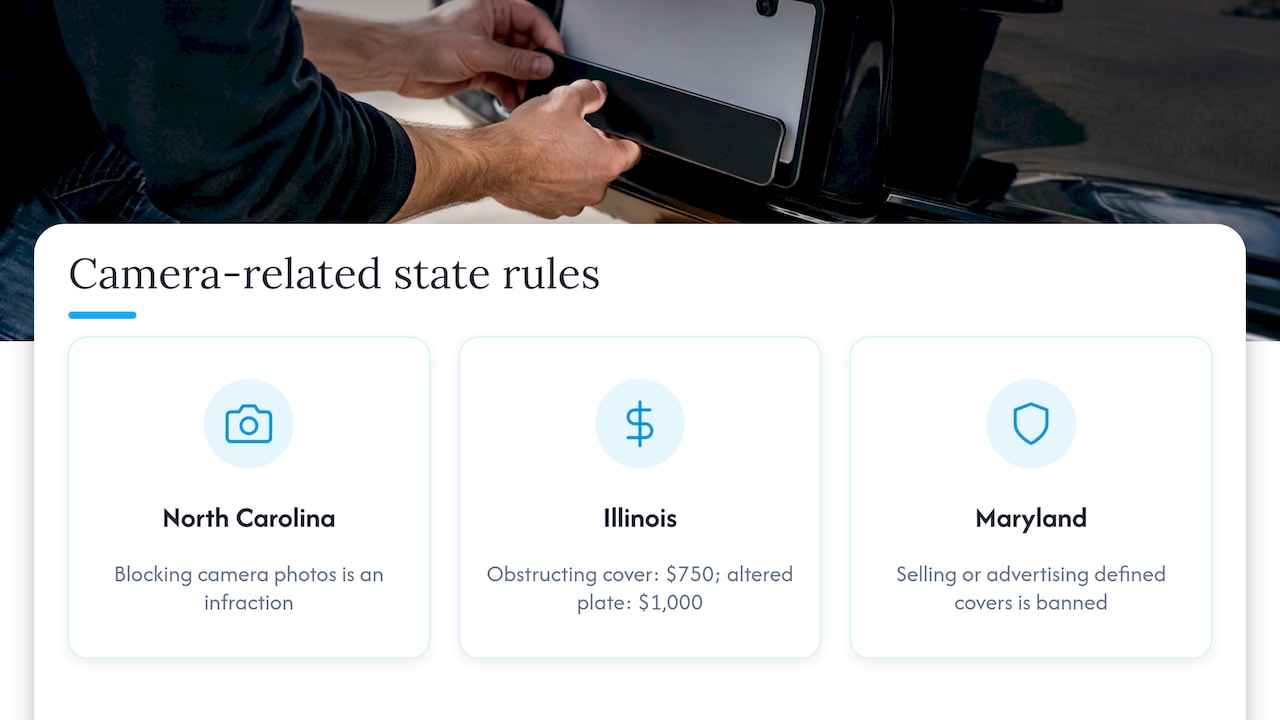
Maryland defines a registration plate cover as any tinted, colored, painted, marked or illuminated object designed to block plate characters or distort an image captured by a traffic-control signal monitor, and bans selling or advertising such covers.
The reason for this wave of rules is money. AAA Northeast’s Alec Slatky says, in the AAA piece above, that cashless tolling and New York City congestion pricing have pushed demand for plate-disguising kits. For readers who want the Illinois angle in more detail, see our write-up on toll camera rules in Illinois.
Fines and penalties by state
Penalties have hardened quickly. Here is what the official sources say.
| State | What is covered | Penalty |
|---|---|---|
| New York (Sept. 1, 2024) | Sale of plate covers banned; obscuring a plate to avoid detection or tolls | $100 to $500, surrender of the cover, 90-day registration suspension after three or more convictions in five years |
| Pennsylvania (Act 150 of 2024) | Possessing, operating with, buying, installing or selling a plate flipping device | Summary offense, $2,000 fine |
| Florida (effective Oct. 1, 2025) | Buying or possessing an obscuring device; selling one; using one to commit or evade detection for a crime | Second-degree misdemeanor; first-degree misdemeanor; third-degree felony |
| California (AB 1085, effective Jan. 1, 2026) | Selling or making a device that obscures a plate; operating with one | $1,000 per item sold or made; $250 per violation for operating |
| Hawaii (Act 124 of 2025) | Plate flipping devices; covers over a plate meant to interfere with identification | $750 to $1,000 per violation for flippers; $500 to $1,000 per offense for covers |
| Wisconsin (2025 Act 37, effective Nov. 2, 2025) | Possessing, selling, buying, installing or using a plate concealment device | Up to $1,000, up to 90 days in jail, or both; vehicle impoundment possible |
| Georgia (2026 SB 293) | Willfully covering a plate to impede surveillance equipment | Misdemeanor, fine of at least $750 or up to 12 months’ confinement, or both |
Two patterns stand out. First, states are moving from “you may not drive with it” to “you may not possess, buy or install it.” Florida’s law makes buying or possessing an obscuring device a misdemeanor. A Jacksonville.com report puts it at up to a $500 fine and up to 60 days in jail, with far higher penalties for using one while committing or fleeing a crime. Second, electronic and mechanical switching devices are named outright. Wisconsin’s law covers manual, electronic and mechanical devices alike.
Kansas shows a softer approach. Its SB 403, effective July 1, 2026, requires the registration number, state of issue and decal month and color to stay visible. According to the Kansas City Star, officers issue only warnings until January 1, 2027.
If you have already been cited, our guide to fixing a plate cover ticket walks through the steps. Laws change often, so check your state’s statute or DMV page for the current text before you act.
Blackout cover versus a black state-issued plate
The phrase “blackout plate” covers two very different things.
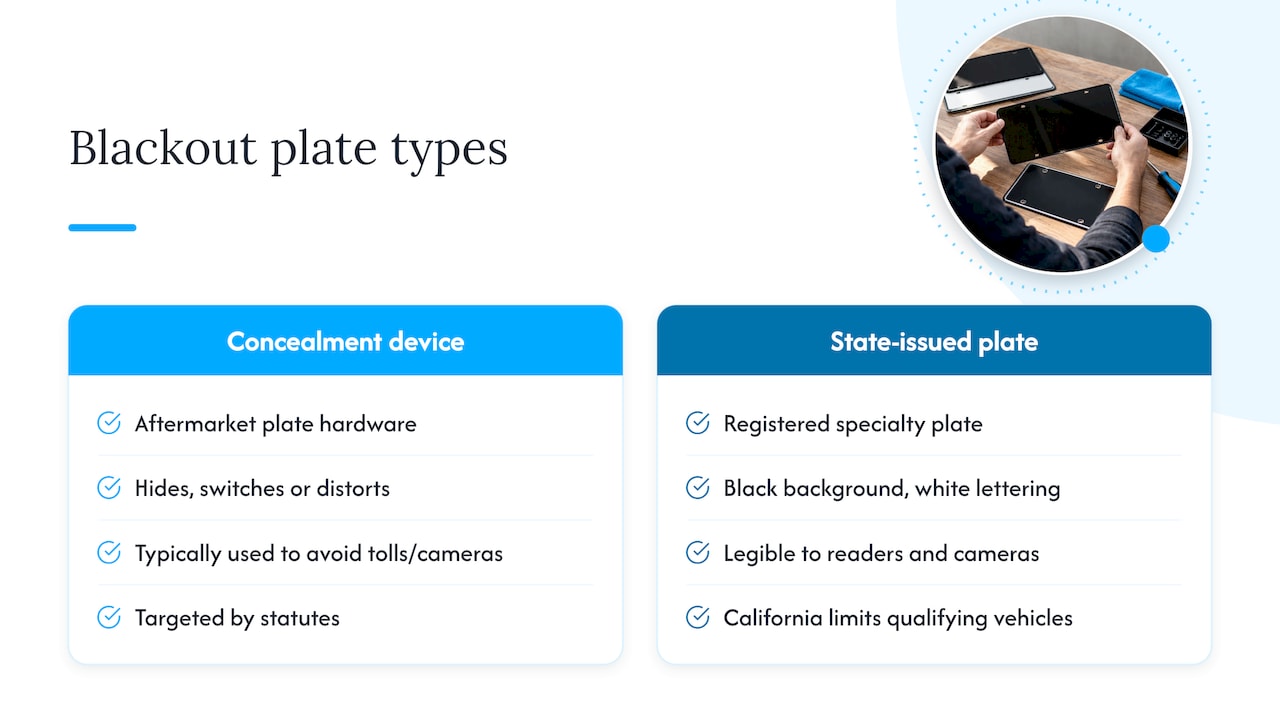
A ghost plate or concealment device is aftermarket hardware that hides, switches or distorts a registered plate. AAA says drivers using such plates are typically trying to avoid tolls or red-light and speed cameras. This is the category the statutes above target.
An officially issued black plate is a registered specialty plate with a black background and white lettering, issued by a state. Colorado, Iowa and Mississippi were among the states offering them, according to MPR News, and Iowa issued nearly half a million in its first three years. Capitol News Bureau reports that at least 10 states, including Iowa, Minnesota, North Dakota and Wyoming, allow all-black plates on non-commercial vehicles. South Dakota has proposed $100 per year for them. These plates carry a registered number and remain legible to readers and cameras, which is the opposite of what a cover does.
California is a common point of confusion. Its black plates are DMV-issued specialty plates for qualifying vehicles such as electric vehicles, commercial vehicles, motorcycles and trailers, and cannot be requested for a standard passenger car.
Where a blackout cover fits
Public-road plate rules apply to public roads. Off-road courses, closed circuits, paddocks, show floors and private land are different settings, and that is where motorsport fans and off-road drivers use our covers. A cover that is off during road use and on at a track day or when the vehicle is parked on private property keeps the plate away from view without leaving the product in the way of the law where the law applies.
How you use it is your responsibility. A plate must be displayed and legible on public roads in every state, and the penalties above apply to road use. Before you drive, uncover the plate fully. If you want a sense of what to expect from different approaches, our overview of license plate privacy options compares the types, and why DIY covers draw stops explains the 75-foot visibility problem with homemade solutions.
The Ghost Curtain Cover
Our Ghost Curtain Cover is a mechanical blackout cover with a manual sliding curtain. It fits all standard US and Canadian plates, is weather-sealed, and installs without tools. Measure first if you are unsure; our plate dimensions guide covers the standard 12-inch by 6-inch size. It is priced at $129.99. Same-day shipping is available, and more than 10,000 drivers have bought from us, with a 4.9-star rating from nearly 3,000 reviews.
The Ghost Curtain Cover is the right fit when your plate needs to be out of view at the track, on the trail or at a private event.

For installation details, our installation guide covers both mechanical and electric covers for the US and Canada.
Our perspective
Most of what people read about blackout plates is a list of fines, and the fines are real. We think the clearer way to look at it is by setting. A plate is a legal identifier on a public road, and every state expects it to be readable there. Off the road, at a track, on a course, in a garage or at a show, drivers have good reasons to want it out of sight.
That is why we build covers that are quick to operate and fit every standard US and Canadian plate. A manual sliding curtain on the Ghost Curtain Cover is simple, weather-sealed and installs without tools, so you can set it up in minutes and move on to the part of the day you came for.
Our advice is to know your state’s statute, uncover the plate before you reach public pavement, and treat the cover as equipment for the places where it belongs.
GoGhost
FAQ
Are blackout license plate covers legal in the US?
On public roads, almost never. AAA states that blocking a plate is illegal in almost every state, and every state requires plates to be visible and legible. Off public roads, such as on private property or at a closed track, the road display rules are not the question, but check local rules.
What is a ghost plate?
A ghost plate is a plate hidden or disguised by a cover, flipper or coating so that people or cameras cannot read it. It is not the same as a black plate issued by a state, which is a registered specialty plate with a readable number.
Is owning a cover illegal?
It depends on the state. The National Motorists Association notes that owning one is typically not an offense while using one on a public road can be. However, Florida, Pennsylvania, Wisconsin and Hawaii now also restrict possessing, buying or installing certain devices, so check your state first.
What are the penalties if I am caught?
They vary widely: $100 to $500 in New York, up to $1,000 in Wisconsin, $2,000 in Pennsylvania, and misdemeanor charges in Florida and Georgia. Using a device to evade detection while committing a crime can bring far more serious charges.
Sources
- Are License Plate Covers Illegal? (AAA)
- Blurring the Law (National Motorists Association)
- Louisiana Act No. 322
- Are Tinted License Plate Covers Legal in Wisconsin? (LegalClarity)
- Georgia SB 293
- Florida Statute 320.061
- North Carolina G.S. 20-63
- Illinois 605 ILCS 10/27.2
- Maryland Transportation 13-411.1
- New York DMV consumer alert
- Pennsylvania Title 75, Chapter 37
- Florida HB 253 (Chapter 2025-36)
- California Vehicle Code 5201.1
- Hawaii Act 124
- Wisconsin Legislative Council Act 37 memo
- Jacksonville.com on Florida’s new law
- Kansas City Star on Kansas plate rules
- MPR News on blackout plates
- Capitol News Bureau on all-black plates
- California black license plates (All About Vehicles)